Transport, storage, and room clutter control
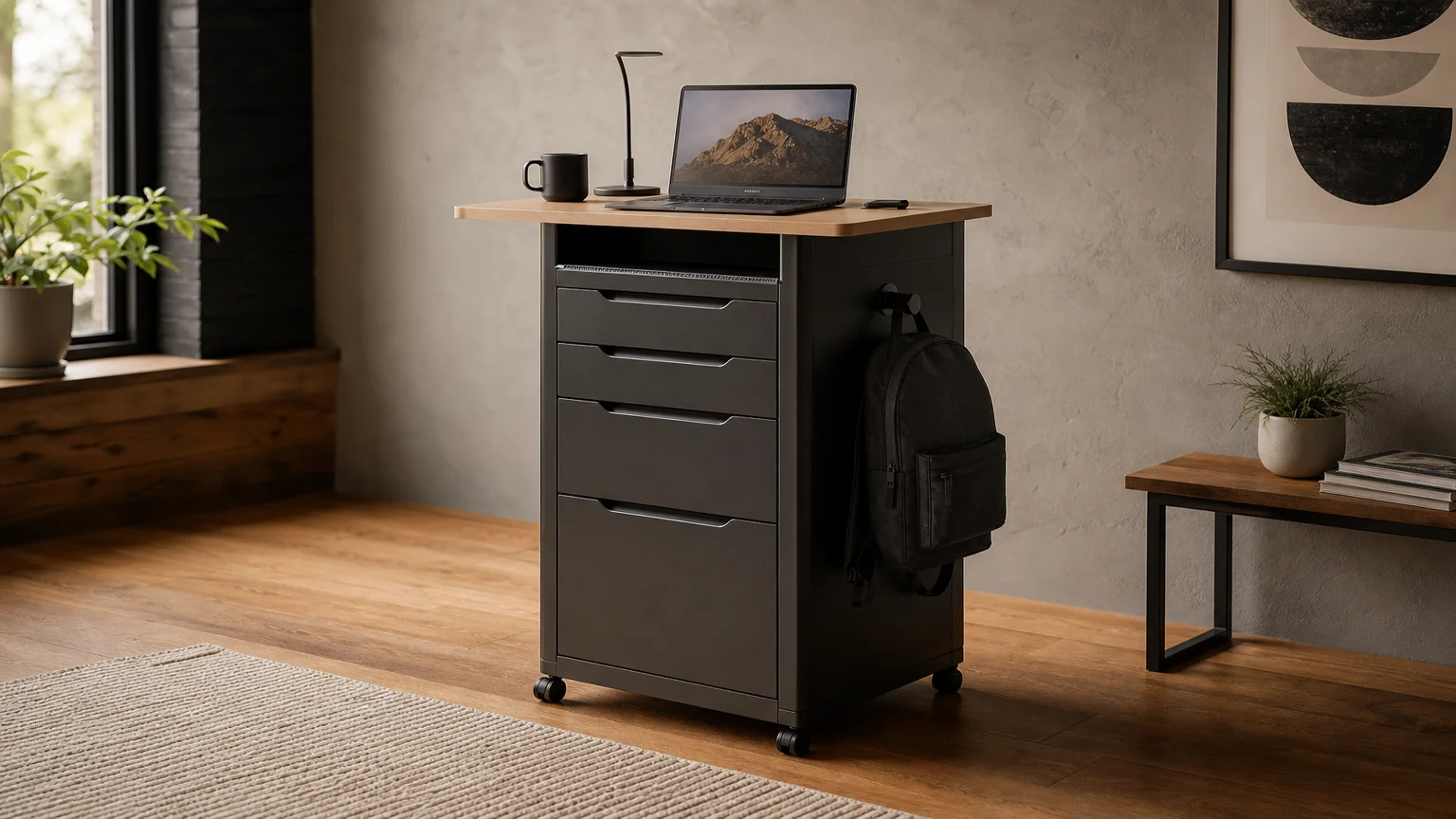
Storage is where compact presentation stands either look polished or collapse into clutter. Treat the top as a working surface, not a permanent display shelf for every product.
Give daily items a shallow, fast-access location and move occasional items into a secondary container. That simple split prevents the common drawer problem where desk tools, stationery, chargers, and receipts become one mixed pile.
Look for drawers that open fully without hitting the stool. A beautiful drawer is not useful if it only opens halfway in the actual room.
Use vertical dividers for brushes, slim bins for stationery, and one small landing tray for the items used every day. Keep the tray small so it cannot become a second junk drawer.
Clean-line storage should make the desk faster to reset, not more complicated. If organization requires ten containers and labels, the setup is probably too fragile for everyday use.
This child page links back to the
main article and the prior cloud page when appropriate.
Storage is where compact presentation stands either look polished or collapse into clutter. Treat the top as a working surface, not a permanent display shelf for every product.
Give daily items a shallow, fast-access location and move occasional items into a secondary container. That simple split prevents the common drawer problem where desk tools, stationery, chargers, and receipts become one mixed pile.
Look for drawers that open fully without hitting the stool. A beautiful drawer is not useful if it only opens halfway in the actual room.
Use vertical dividers for brushes, slim bins for stationery, and one small landing tray for the items used every day. Keep the tray small so it cannot become a second junk drawer.
Clean-line storage should make the desk faster to reset, not more complicated. If organization requires ten containers and labels, the setup is probably too fragile for everyday use.
The practical test is whether the desk still feels calm at the end of a busy day. If the surface cannot be reset quickly, reduce visible items before adding another organizer.
Small-room furniture should be evaluated in motion. Open the nearest closet, walk past the bed, pull the stool back, and check the display surface angle while actually holding the items used every morning.
A good support setup also respects maintenance. Dust should be easy to reach, cords should not trap hair or lint, and drawer dividers should lift out without a full reorganization.
When comparing models, give more weight to clearance, drawer behavior, finish durability, and light placement than to decorative styling alone.
Storage is where compact presentation stands either look polished or collapse into clutter. Treat the top as a working surface, not a permanent display shelf for every product.
Give daily items a shallow, fast-access location and move occasional items into a secondary container. That simple split prevents the common drawer problem where desk tools, stationery, chargers, and receipts become one mixed pile.
Look for drawers that open fully without hitting the stool. A beautiful drawer is not useful if it only opens halfway in the actual room.
Use vertical dividers for brushes, slim bins for stationery, and one small landing tray for the items used every day. Keep the tray small so it cannot become a second junk drawer.
Clean-line storage should make the desk faster to reset, not more complicated. If organization requires ten containers and labels, the setup is probably too fragile for everyday use.
The practical test is whether the desk still feels calm at the end of a busy day. If the surface cannot be reset quickly, reduce visible items before adding another organizer.
Small-room furniture should be evaluated in motion. Open the nearest closet, walk past the bed, pull the stool back, and check the display surface angle while actually holding the items used every morning.
A good support setup also respects maintenance. Dust should be easy to reach, cords should not trap hair or lint, and drawer dividers should lift out without a full reorganization.
When comparing models, give more weight to clearance, drawer behavior, finish durability, and light placement than to decorative styling alone.
Storage is where compact presentation stands either look polished or collapse into clutter. Treat the top as a working surface, not a permanent display shelf for every product.
Give daily items a shallow, fast-access location and move occasional items into a secondary container. That simple split prevents the common drawer problem where desk tools, stationery, chargers, and receipts become one mixed pile.
Look for drawers that open fully without hitting the stool. A beautiful drawer is not useful if it only opens halfway in the actual room.
Use vertical dividers for brushes, slim bins for stationery, and one small landing tray for the items used every day. Keep the tray small so it cannot become a second junk drawer.
Clean-line storage should make the desk faster to reset, not more complicated. If organization requires ten containers and labels, the setup is probably too fragile for everyday use.
The practical test is whether the desk still feels calm at the end of a busy day. If the surface cannot be reset quickly, reduce visible items before adding another organizer.
Small-room furniture should be evaluated in motion. Open the nearest closet, walk past the bed, pull the stool back, and check the display surface angle while actually holding the items used every morning.
A good support setup also respects maintenance. Dust should be easy to reach, cords should not trap hair or lint, and drawer dividers should lift out without a full reorganization.
When comparing models, give more weight to clearance, drawer behavior, finish durability, and light placement than to decorative styling alone.
Storage is where compact presentation stands either look polished or collapse into clutter. Treat the top as a working surface, not a permanent display shelf for every product.
Give daily items a shallow, fast-access location and move occasional items into a secondary container. That simple split prevents the common drawer problem where desk tools, stationery, chargers, and receipts become one mixed pile.
Look for drawers that open fully without hitting the stool. A beautiful drawer is not useful if it only opens halfway in the actual room.
Use vertical dividers for brushes, slim bins for stationery, and one small landing tray for the items used every day. Keep the tray small so it cannot become a second junk drawer.
Clean-line storage should make the desk faster to reset, not more complicated. If organization requires ten containers and labels, the setup is probably too fragile for everyday use.
The practical test is whether the desk still feels calm at the end of a busy day. If the surface cannot be reset quickly, reduce visible items before adding another organizer.
Small-room furniture should be evaluated in motion. Open the nearest closet, walk past the bed, pull the stool back, and check the display surface angle while actually holding the items used every morning.
A good support setup also respects maintenance. Dust should be easy to reach, cords should not trap hair or lint, and drawer dividers should lift out without a full reorganization.
When comparing models, give more weight to clearance, drawer behavior, finish durability, and light placement than to decorative styling alone.
Storage is where compact presentation stands either look polished or collapse into clutter. Treat the top as a working surface, not a permanent display shelf for every product.
Give daily items a shallow, fast-access location and move occasional items into a secondary container. That simple split prevents the common drawer problem where desk tools, stationery, chargers, and receipts become one mixed pile.
Look for drawers that open fully without hitting the stool. A beautiful drawer is not useful if it only opens halfway in the actual room.
Use vertical dividers for brushes, slim bins for stationery, and one small landing tray for the items used every day. Keep the tray small so it cannot become a second junk drawer.
Clean-line storage should make the desk faster to reset, not more complicated. If organization requires ten containers and labels, the setup is probably too fragile for everyday use.
The practical test is whether the desk still feels calm at the end of a busy day. If the surface cannot be reset quickly, reduce visible items before adding another organizer.
Small-room furniture should be evaluated in motion. Open the nearest closet, walk past the bed, pull the stool back, and check the display surface angle while actually holding the items used every morning.
A good support setup also respects maintenance. Dust should be easy to reach, cords should not trap hair or lint, and drawer dividers should lift out without a full reorganization.
When comparing models, give more weight to clearance, drawer behavior, finish durability, and light placement than to decorative styling alone.
Storage is where compact presentation stands either look polished or collapse into clutter. Treat the top as a working surface, not a permanent display shelf for every product.
Give daily items a shallow, fast-access location and move occasional items into a secondary container. That simple split prevents the common drawer problem where desk tools, stationery, chargers, and receipts become one mixed pile.
Look for drawers that open fully without hitting the stool. A beautiful drawer is not useful if it only opens halfway in the actual room.
Use vertical dividers for brushes, slim bins for stationery, and one small landing tray for the items used every day. Keep the tray small so it cannot become a second junk drawer.